
Say it together
The question and the answer are the same word.
Yasmine’s family speaks Darija, Moroccan Arabic. Written Arabic runs from right to left. In the story, Yasmine’s grandmother also greets Alexandria with Azul, a Tamazight hello.
Tap the ear to listen. Say the word together. Turn the card over if you would like to hear your own voice.
Listen as often as you like. Recording is optional.
Watch the hands that make it
A square, fold by fold.
Meet Dada Rabia, a cook at La Maison Arabe in Marrakech. In Cooking With Alia’s film, she folds msemen dough. Watch which edges she brings together.
Watch, read or listen together. Rabia sprinkles the thin dough, folds two opposite edges inward to make a long shape, then folds the remaining ends over each other. A square is ready. These are her skilled hands making the breakfast from our story.
What did Rabia’s hands help you notice? Later, use paper to fold a drawing or tiny story for someone you know. We are watching the cooking; our class gift uses paper.
Marrakech · Yasmine’s breakfast
Something warm to share.
Yasmine carries warm msemen under a cloth. Lift the cloth and help her share the plate.
The cloth covers the warm breakfast.
From Alexandria’s World: Marrakech, Morocco, pages 7–9.
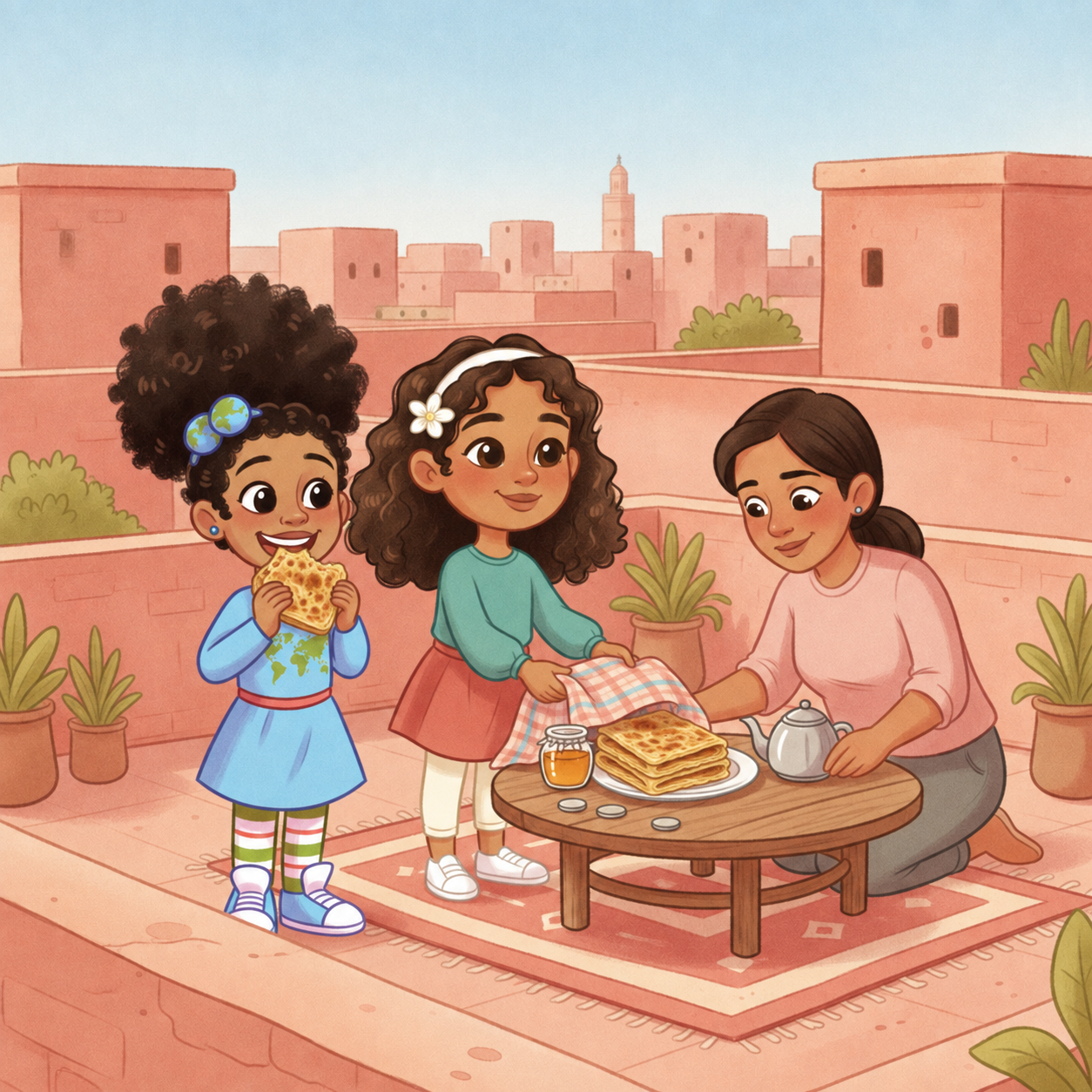
A small thing, carried with care.
Yasmine helps her family share breakfast with people they know. The food matters. So does the hello.
Tell a partner how you might welcome someone you already know. Listen to their idea, too.
Make it together
A plate of little stories.
Yasmine carries something made with care. Make a paper gift to share with someone in your class.
- Fold a little giftDraw a tiny story or a favourite detail from your day on a paper square. Fold it closed. Every child makes one.
- Gather the platePut the folded squares on a paper plate or a circle drawn on paper. Cover them with a cloth or a sheet of paper.
- Offer it with a helloAsk a classmate, “Would you like my story?” If they say yes, pass your folded gift with a spoken or gestured greeting.
The receiver opens the gift and points to something they notice. The maker tells the story, or asks a partner to help. After listening, add a detail or decide what to keep. Take turns so everyone can make and receive a gift.
Carry a little story home.
With a trusted grown-up, make a folded drawing for someone you already know. Ask before sharing it. Listen to what they notice, then tell them the story behind your drawing.
Open the paper gift to printNo printer? Fold any paper square. No food, shopping, or cooking is needed.
Carry a little Marrakech with you.
A hello and something made with care can travel together.
For grown-ups
Make a class sharing plate
Gather
Allow 25–35 minutes. Bring paper squares, drawing tools, a paper plate or drawn circle, and a cloth or extra sheet of paper. Read the Marrakech story at pages 7–9. One projected screen or the book is enough for the whole class.
Guide the handoff
Each child makes a folded drawing or tiny story. Gather the gifts on a paper plate under a cloth, then invite each maker to offer their own gift with a spoken or gestured greeting. The receiver can accept or pass. A partner may help make or tell the story. Every child has a making and receiving role.
Notice the learning
The receiver points to what they notice; the maker explains their drawing. The maker adds a detail or explains what they want to keep after hearing that response. Children can draw, point, speak, or use a partner’s voice.
Carry it forward
At home, a trusted grown-up helps choose a known person to offer a folded drawing. Ask before offering the gift; a person may choose to pass. No visits to unfamiliar doors are part of this lesson. No food, shopping, or cooking is needed. Any real food activity is a separate adult decision, including allergies and preparation.
Using the page
The plate activity sends and stores no child information. Passport stamps stay only in this browser. Optional word recordings use the microphone only after permission and remain in this page until it closes. Paper alone gives every child the same making and sharing experience.
Film sources and watching together
Original film: Cooking With Alia, episode 696, with Dada Rabia of La Maison Arabe. Selected part 2:11–2:39, shown in the creator’s YouTube player.
The optional film uses the original YouTube player. Pause, seek or leave it at any time. This lesson returns to its own picture after the selected part. The visible description provides the same observation when video is blocked or unwanted. The source service can change its captions, advertising and controls; a grown-up can preview the full source. Children do not need to open it.
Why we learn this way
The folded gift and its real handoff are the evidence of learning. Each child makes a drawing or tiny story, offers it to a known person who may accept or pass, and shows one deliberate choice.
The receiver points to what they notice. The maker explains, then adds a detail or says why they want to keep the gift as it is. An adult helps with a fold or a greeting without taking over the child’s message.
Carry the practice to a trusted person at home. A drawing, a gesture or a partner’s voice can carry the message. The cycle is make, explain, reflect, look again and use it with someone you know.
History, evidence and perspective
Yasmine’s family in the book and Rabia’s real demonstration are particular accounts. They do not stand for every home in Marrakech. Distinguish a story illustration, a dated photograph, a constructed view and a filmed practice. Ask who made each one, what it can show and what you would still like to ask the person.
For the city’s longer history, UNESCO’s Medina of Marrakesh record describes its historic buildings and its continuing life as a town. Do not infer the age of a family practice from an old building, or treat a living neighborhood as frozen in the past.
Reading behind the approach. Carlos E. Cortés connects honest attention to the past with action in the present and future in Renewing Multicultural Education (2025). We adapt that direction through a child’s own experience, another person’s account and something made together. Tervalon and Murray-García’s cultural humility (1998) asks us to keep examining our assumptions, attend to power and learn in accountable relationships. Their original work concerns medical education; this lesson applies those commitments to meeting people and cultures.
Travel and map sources
Current operator information is for adults planning an actual visit. The child’s map stays inside the lesson.
Map display: OpenFreeMap and OpenMapTiles, with OpenStreetMap data under the Open Database License. The map uses MapLibre.
Photograph credit
Marrakech city wall, Hans Birger Nilsen, CC BY-SA 2.0. Resized for this page; the visible crop adjusts to the screen.